
Blérancourt celebrates America 250, Everywhere
/
When General Pershing arrived in Paris in 1917, the first thing he did was visit Lafayette's tomb. The gesture of Americans honoring the Frenchman who helped them win their independence is exactly the spirit on which the Franco-American Museum of Blérancourt was built. A gift from Anne Morgan to France to tell the story through art of a complex and unique 250-year-old relationship.
Curator Valérie Lagier guides us through its collection, one story at a time.
In this first conversation, Valérie Lagier tells us about the pieces the museum has loaned to two exhibitions: a current one at the Archives Nationales in Paris, and another opening in June at the musée du Nouveau Monde in La Rochelle.
American Friends of Blérancourt: Valérie, what artworks did the Franco-American Museum of Blérancourt loan to the Archives Nationales for the exhibition "Lafayette, Between France and America: History and Legends?"
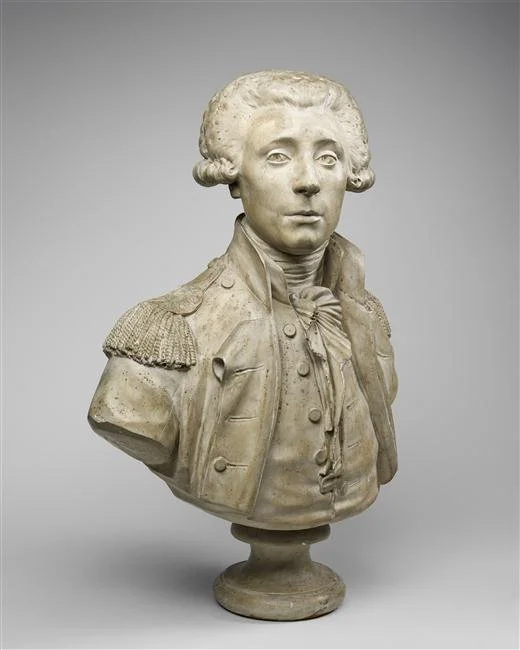
Valérie Lagier: The first sculpture visible at the start of the exhibition is a bust of Lafayette sculpted by Houdon in 1790. While the original sculpture remained in Versailles, we lent a plaster cast from our collection. It depicts Lafayette in the uniform of the National Guard during the French Revolution, not during the War of Independence. It is an extremely well-known bust that has been reproduced in plaster cast many times.
AFB: Houdon was well known for his portraits of America's Founding Fathers, wasn't he?
Valérie Lagier: Indeed. Houdon portrayed all the Founding Fathers of the American War of Independence, including the very large portrait of Washington, which is in Virginia, and of which we have a copy here at the entrance to the museum.
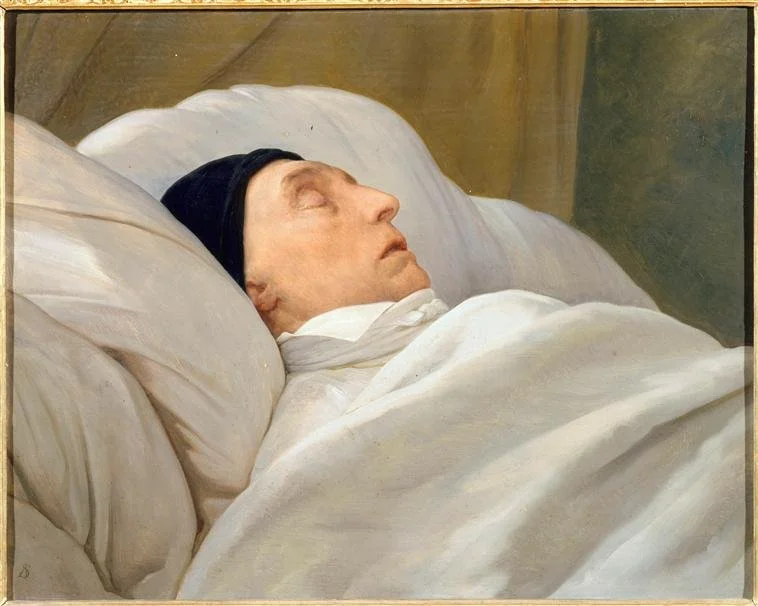
AFB: The other artwork the museum lent to the Archives Nationales is a painting.
Valérie Lagier: A painting representing Lafayette on his deathbed, by Ary Scheffer, a friend of Lafayette who had painted one of his finest portraits during his lifetime. This portrait of Lafayette on his deathbed was very probably commissioned by Lafayette's family. It belonged to his son, who was named Georges Washington Lafayette.
AFB: If Lafayette is the most famous French person in the history of the birth of the United States, the American Benjamin Franklin played a very important role as well, but this time in France. And the works the Blérancourt museum lent to the upcoming exhibition at the musée du Nouveau Monde in La Rochelle are about Benjamin Franklin.
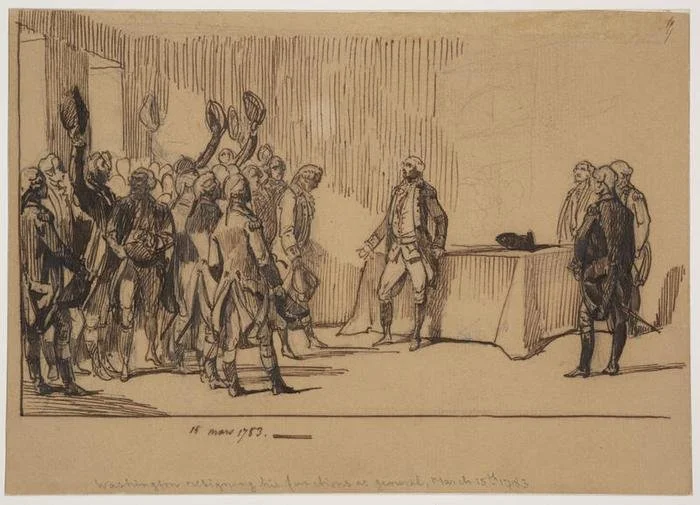
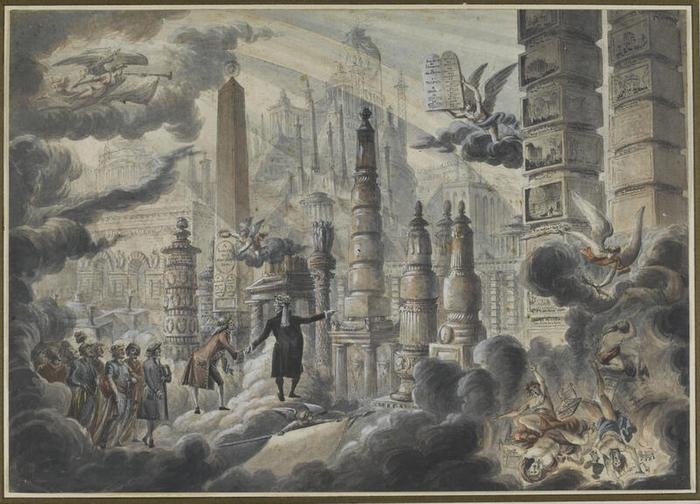
Valérie Lagier: The musée du Nouveau Monde in La Rochelle is hosting an exhibition in June on the Declaration of Independence, for which we are lending four works: a bust of Benjamin Franklin, a large drawing of Benjamin Franklin with Voltaire and Rousseau, two drawings by Armand-Dumaresq showing Washington relinquishing command of the troops to become the first President of the US, and a very small drawing depicting the signing of the Declaration of Independence.
Illustrations | above: Lafayette by Houdon, Lafayette on his deathbed by Ari Scheffer | below: George Washington resigning his military command by Armand-Dumaresq, Drawing Benjamin Franklin with Voltaire and Rousseau, Benjamin Franklin by Houdon (courtesy of the Franco-American Museum of Château de Blérancourt)
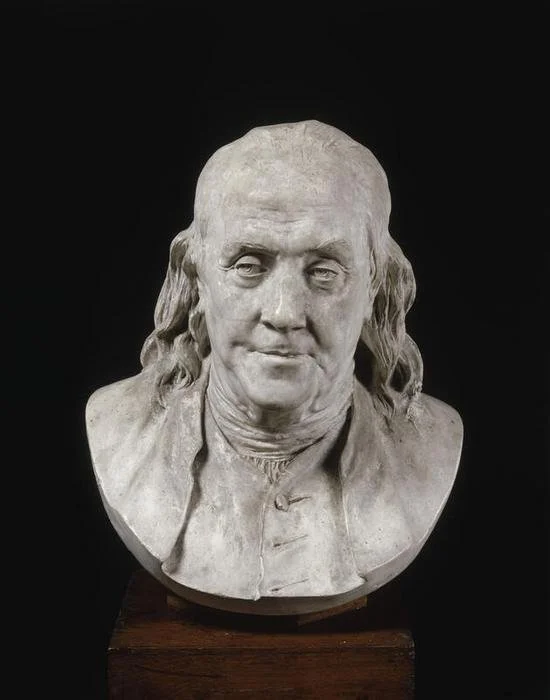
AFB: This exhibition will show how the French people perceived the events that marked the battle for independence in America and the birth of a new political system. The kingdom of France played a key role in helping the independentists win their war. But French support began even before any official commitment — isn't that right?
Valérie Lagier: The first battles of the war began in 1776, and from the very start, the King of France channeled money through Beaumarchais, well before any formal alliance.
AFB: How is the War of Independence represented at the Franco-American Museum of Blérancourt?
Valérie Lagier: The Blérancourt museum addresses this period permanently. We did not wait for the celebrations to evoke the Franco-American friendship forged during the War of Independence. The first room of the museum is called "The Ideals," and it brings together all the museum's masterpieces dedicated to French participation in the War of Independence.
There is also the Armand-Dumaresq drawing showing the signing of the Declaration of Independence 100 years later, a drawing that prepared a painting sent to Philadelphia in 1876 for the World's Fair commemorating the centennial of the Declaration.
It took us a long time to find that painting, and the miracle of art history is that this year we found it, and it will very likely be lent to Versailles for the opening of the Vergennes gallery.
In that room, we have portraits of all the Founding Fathers: Benjamin Franklin, Thomas Jefferson, George Washington, and we also have portraits of Lafayette and Louis XVI. We have almost all the principal figures of this collaboration sealed during the War of Independence, and we also have this very interesting sculptural group depicting the moment when Louis XVI hands Benjamin Franklin the Treaty of Amity and Commerce. We also have an original copy of the treaty, signed on February 6th, 1778 between Louis XVI and Benjamin Franklin, which recognized the independence of the United States.
AFB: You mention the Founding Fathers. How was the sculptor Houdon able to sculpt them?
Valérie Lagier: One of our exceptional archives is a very moving letter from Thomas Jefferson recommending Houdon to Congress so that he might be commissioned in the United States to portray the Founding Fathers.
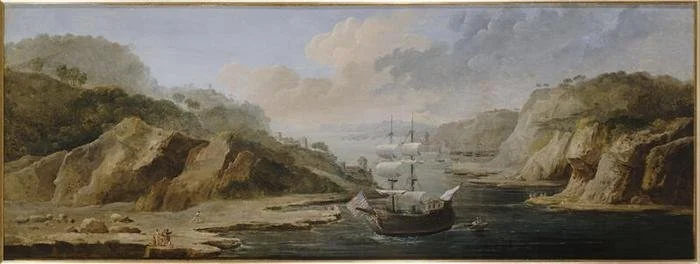
Illustration: The Victoire departure by Hubert Robert (courtesy of the Franco-American Museum of Château de Blérancourt)
AFB: Anne Morgan was very attached to the memory of what is the beginning of a long and complex relationship between France and the United States.
Valérie Lagier: Anne Morgan and Anne Murray Dike, from the outset, chose to evoke the War of Independence through very fine artworks. We have two very fine Salon paintings donated by Anne Morgan, showing the departure of an officer from Rochambeau's army for this extraordinary, and yet bloody, adventure to aid the insurgents, and another painting showing the return of this young officer, decorated with the Cross of Saint-Louis — as were all the officers who participated in the War of Independence — and to whom the hand of a young woman is offered in reward.
AFB: This shows what the museum is all about — remembering and telling the history of the relationship between the two countries through art.
Valérie Lagier: This is the defining characteristic of the museum from the very beginning. It is a history-themed museum made up entirely of works of art.
AFB: And this starts with Lafayette, of course.
Valérie Lagier: We find Lafayette almost everywhere and at every age, right up to his death. We also have a very fine painting by Hubert Robert showing the departure of the Victoire on Lafayette's first voyage to America.
AFB: Not on the Hermione?
Valérie Lagier: The Hermione was the ship on which his second voyage took place. The Victoire was a ship he fitted out at his own expense, since he was very wealthy at the lofty age of 19 — he had inherited from many people — and so he set off with other volunteers and arrived in America to lend support to Washington's troops. Though at first things did not go so smoothly, he was later recognized by Washington and became almost his spiritual son.
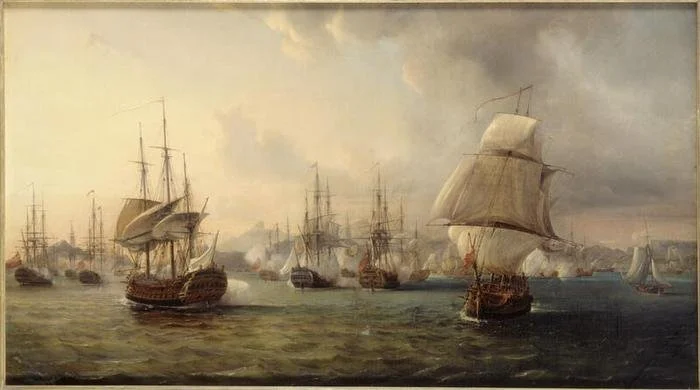
Illustration: The battle of Porto Praia (courtesy of the franco-american Museum of Château de Blérancourt)
AFB: The museum also showcases artworks depicting the battles.
Valérie Lagier: We have a painting from Versailles showing the Battle of Porto Praya, a naval battle that did not take place off the American coast. Contrary to what one might think, many naval battles did not take place along the US coastline; a great deal of the fighting in the War of Independence took place in the Caribbean but also in the Cape Verde Islands. It was in fact, a total war.
AFB: Off the coast of Africa!
Valérie Lagier: What is not often said about the War of Independence is that it was not only the French who were involved, but also the Spanish and the Dutch. The Battle of Porto Praya was aimed at defending the Dutch against the English — alliances forming that required battles in various places. Every battle won against the English navy meant that many fewer ships would be fighting off the American coast. It was a total war, but fortunately for France, one that did not draw in the other European countries, which preferred to remain neutral. And that is what ultimately allowed France to prevail alongside the independentists against the English.
AFB: This is a story that finds its roots in Versailles — and that will be the topic of our next conversation. Thank you, Valérie Lagier, curator of the Franco-American Museum of Blérancourt.
Next week: How Versailles became the birthplace of American independence.
Visitor information:
Musée franco-américain du château de Blérancourt
Place du général Leclerc, 02300 Blérancourt, France
Open daily from 10:00 a.m. to 12:30 p.m. and from 2:00 p.m. to 6:00 p.m.
(last admissions at 11:45 a.m. and 5:15 p.m.).
Closed on Tuesdays, January 1, May 1, and December 25
Musée des Archives nationales
Exhibition: Lafayette entre France et Amérique. Histoire et légende
April 1 > July 14, 2026
L’hôtel de Soubise, 60, rue des Francs-Bourgeois, 75003 Paris, France
Open Monday to Friday from 10:00 a.m. to 5:30 p.m.
Saturday and Sunday from 2:00 p.m. to 7:00 p.m.
Closed on Tuesdays and May 1
Musée du nouveau monde
Exhibition: Les Français et la naissance des États-Unis
June 19 > November 16, 2026
10 Rue Fleuriau, 17000 La Rochelle, France
Monday, Wednesday, Thursday, Friday, Sunday, and public holidays: 10:00 a.m. to 6:00 p.m.
Saturday: 2:00 p.m. to 6:00 p.m.
Closed on January 1, May 1, July 14, November 1 and 11, December 25
About Valérie Lagier: Valérie Lagier is currently working as chief curator at the Franco-American Museum in Blérancourt. After graduating in History and Art History, she took a national competition to become a curator and was trained in the School of National Heritage in Paris. She started her career as an Art curator in the Museum of Fine Arts in Rennes, organizing major exhibitions on contemporary Art. She was also in charge of the Educational Department where she made innovative efforts to make art collections more accessible to museum visitors. She was part of a cooperation program between French and American museums (FRAME). Then she became Deputy Director of Studies at the National Institute of Cultural Heritage in Paris, where she oversaw the training of curators. Her two last positions were Director of the Vitré Museums and Castles and curator of Drawings at the Art Museum of Grenoble, organizing exhibitions and writing catalogues of the collection, especially on 19th Century Art. She has published many exhibitions catalogues, scientific articles and many education books of Art for adults, teenagers and kids, especially Dicover the Louvre Together and Discover the Musée d’Orsay together, published in both French and English.
