
Anne Morgan and Art, Guardians of the Memory of American Independence
/What would remain of a historical event without a text, an image, a sculpture, or the work of a historian to bear witness to its existence? In 1924, when Anne Morgan decided to transform the Château de Blérancourt - whose ruins she had acquired five years earlier - into a museum, she sought to bring together works of art, objects, and testimonies, each reflecting the French and American actions that helped give birth to the United States.
American Friends of Blérancourt (AFB): How does the museum tell the story of the origins of the relationship between France and the United States?
Valérie Lagier, Chief Curator of the Franco-American Museum at the Château de Blérancourt (VL): The museum features a magic mirror that places the texts of the American Declaration of Independence and the Declaration of the Rights of Man and of the Citizen side by side, highlighting what they have in common. Thomas Jefferson played a major role in drafting the Declaration of Independence, which later inspired Lafayette in his work on the Declaration of the Rights of Man and of the Citizen. It is therefore no coincidence that the two texts share common themes and founding principles. The Declaration of Independence also reflects the influence of European and British Enlightenment ideas, which contributed to the birth of American democracy.
It is important to remember that our democracies rest on common foundations, even though they later evolved differently. France is a centralized state, while the United States is a federal one. Geography also plays a role: one is a relatively small country, the other an immense territory. But at the outset, there was a genuine dialogue of ideas.
AFB: How does this national history connect to the Blérancourt region?
VL: That is precisely one of the interesting aspects of the exhibition. Anne Morgan donated to the museum a complete collection of gouaches depicting the uniforms of Louis XVI’s regiments. Some of these soldiers took part in the American War of Independence.
For the exhibition, we chose to display the uniforms of the Soissonnais Regiment. Since we are in the Soissonnais region, it was important to recall that this area also played a part in the War of Independence, particularly in the Battle of Yorktown. Officers from the Blérancourt region went to fight in America.
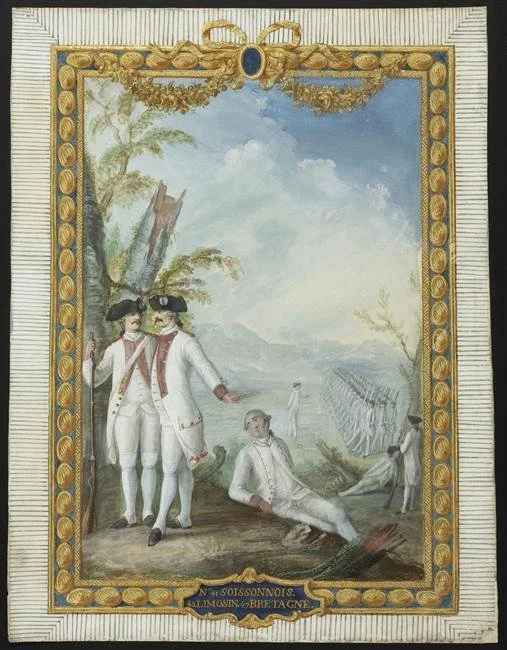
the uniforms of the Soissonnais Regiment
Two paintings, also donated by Anne Morgan, tell the story of this departure in a more intimate way: the first shows an officer in Louis XVI’s army leaving France to fight in the War of Independence; the second depicts his return, when a young woman is presented to him as his future wife.
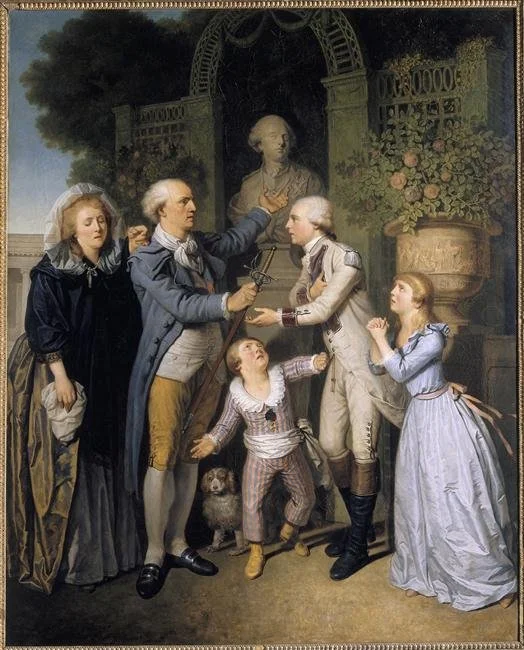
officer in Louis XVI’s army leaving France to fight in the War of Independence
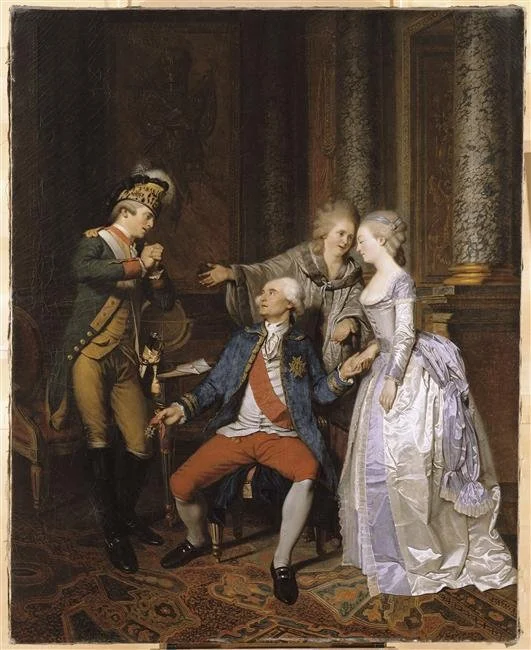
return of the officer. a young woman is presented to him as his future wife.
AFB: Did art play a role in the way this history has been passed down to us?
VL: Art has helped fix this history in the collective memory. Many of the great works we now associate with the War of Independence were actually created after the events themselves. They do not necessarily provide an exact representation of what happened on a particular day, but they give form to a historical moment and ultimately become its defining image.
A single event, such as the signing of a document or a battle, can therefore give rise to several representations. Over time, one of these images may come to dominate the collective imagination. It transforms a past event into a symbolic moment that is immediately recognizable to the public.
AFB: Does contemporary art continue to play this role today in the history of the Franco-American relationship?
VL: Contemporary artists will certainly engage with this moment of commemoration. But since Blérancourt is not a contemporary art museum, it is difficult for us to say today which works will endure and, in turn, become the defining images of this history.
What is certain is that images continue to have a profound impact on us. Painting long played this role; today, photography, journalism, and new forms of artistic expression also shape the way an event is documented, interpreted, and transmitted. Ultimately, the question remains the same: which images of our time will become tomorrow’s symbols of the Franco-American relationship?
AFB: Thank you, Valérie. We will continue this conversation next week.
